
Skip to content
CERIUM

Solutions · Brokerages

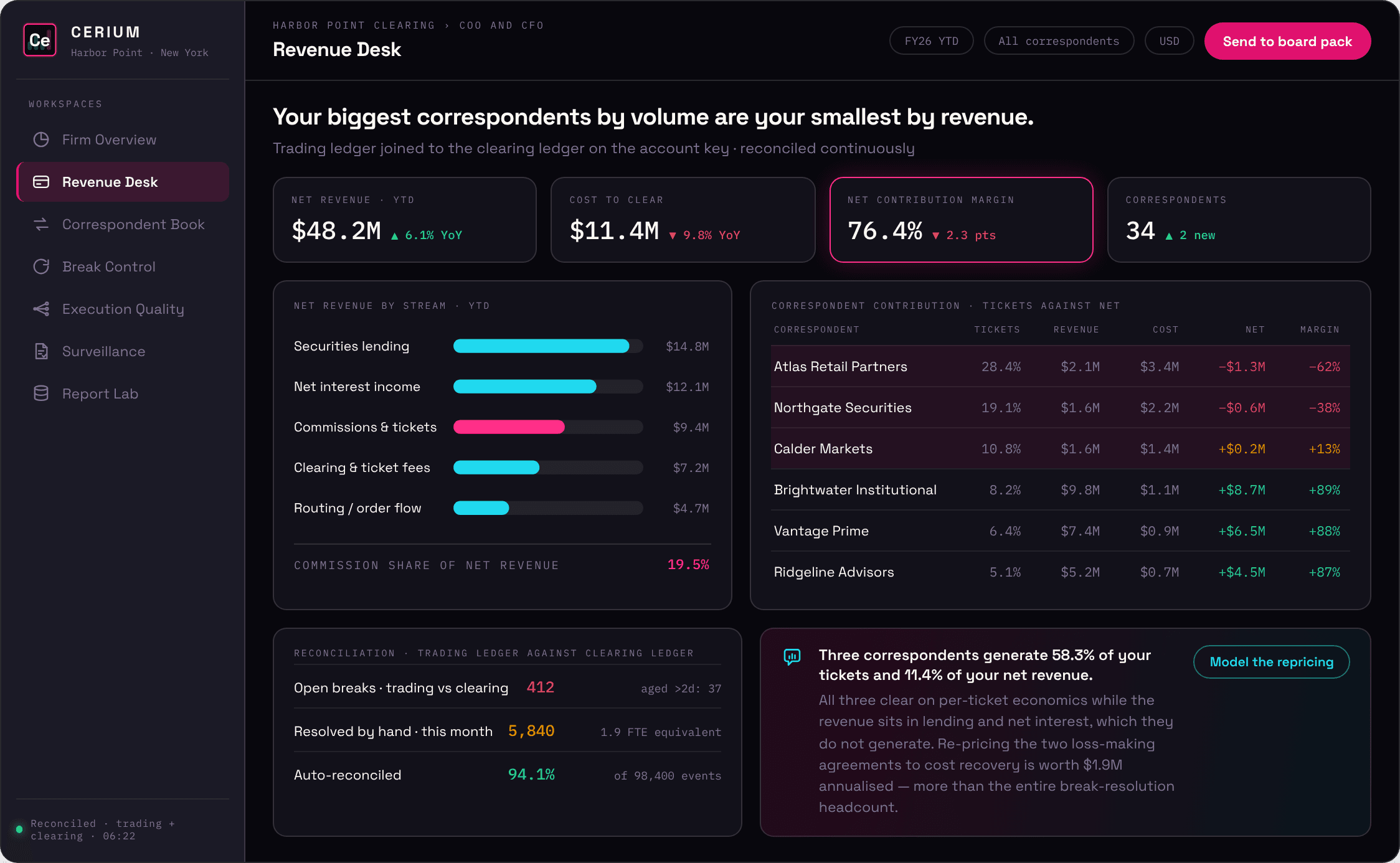
Volume you can measure. Profitability you cannot.

Commissions are now a minority of your revenue and clearing is your largest operating cost. They sit in different systems — so the one number that matters, what a correspondent or a desk actually contributes, is the one nobody can produce.

Cerium · Revenue Desk · demonstration data

The expensive questions.

What does this correspondent actually earn us?

Commissions, ticket charges, securities lending, net interest on balances and routing revenue, set against the cost to clear them. Net contribution per correspondent, per desk, per client — computed from both ledgers rather than estimated from one.

Why do the two ledgers disagree?

Your trading record and your clearing record against each other, continuously rather than overnight. Breaks surfaced with the source conflict named and ranked by exposure rather than by age.

Is our execution defensible?

Fill quality, venue and routing analysis read against the same reconciled book that produced the revenue — so the best-execution evidence and the profitability number come from one model, not two.

Can we show the regulator the working?

Post-trade break detection, settlement discrepancy identification and monitoring of securities transactions, with lineage from every figure back to the row it came from.

Why growth stops reaching the bottom line.

None of this is a reporting failure. The reports are accurate and they arrive on time. The problem is structural, and it sits in three places.

Clearing is priced per ticket. Revenue is not.

Your largest operating cost scales with activity. Your largest revenue lines — securities lending, net interest on cash — scale with assets. A correspondent can be enormous on one and negligible on the other, and a per-ticket agreement never notices.

Breaks scale with volume. So does headcount.

Two ledgers that must agree produce exceptions in proportion to activity. Resolve them by hand and every increment of growth arrives with a hire attached — which is operational leverage running backwards.

T+1 removed the window the model relied on.

Overnight batch reconciliation assumed there was a night. A shorter settlement cycle and extended trading hours took it away. Firms that have not moved to continuous reconciliation are absorbing the difference in people.

Bring us one month of both ledgers.

We will show you where the trading record and the clearing record disagree, what each correspondent actually contributes, and what the gap is costing you. Thirty minutes to scope it.