
Why does won revenue keep arriving light?
The CRM says one number and the ledger says another. Cerium joins them on the merchant key and decomposes the difference into discount at signing, ramp shortfall, scope reduction and year-one churn.
Solutions · Payment processors
Cerium joins your CRM pipeline to your revenue ledger on the merchant key, shows where sold revenue leaks before it lands, and predicts the gap at signature rather than reporting it at year end.
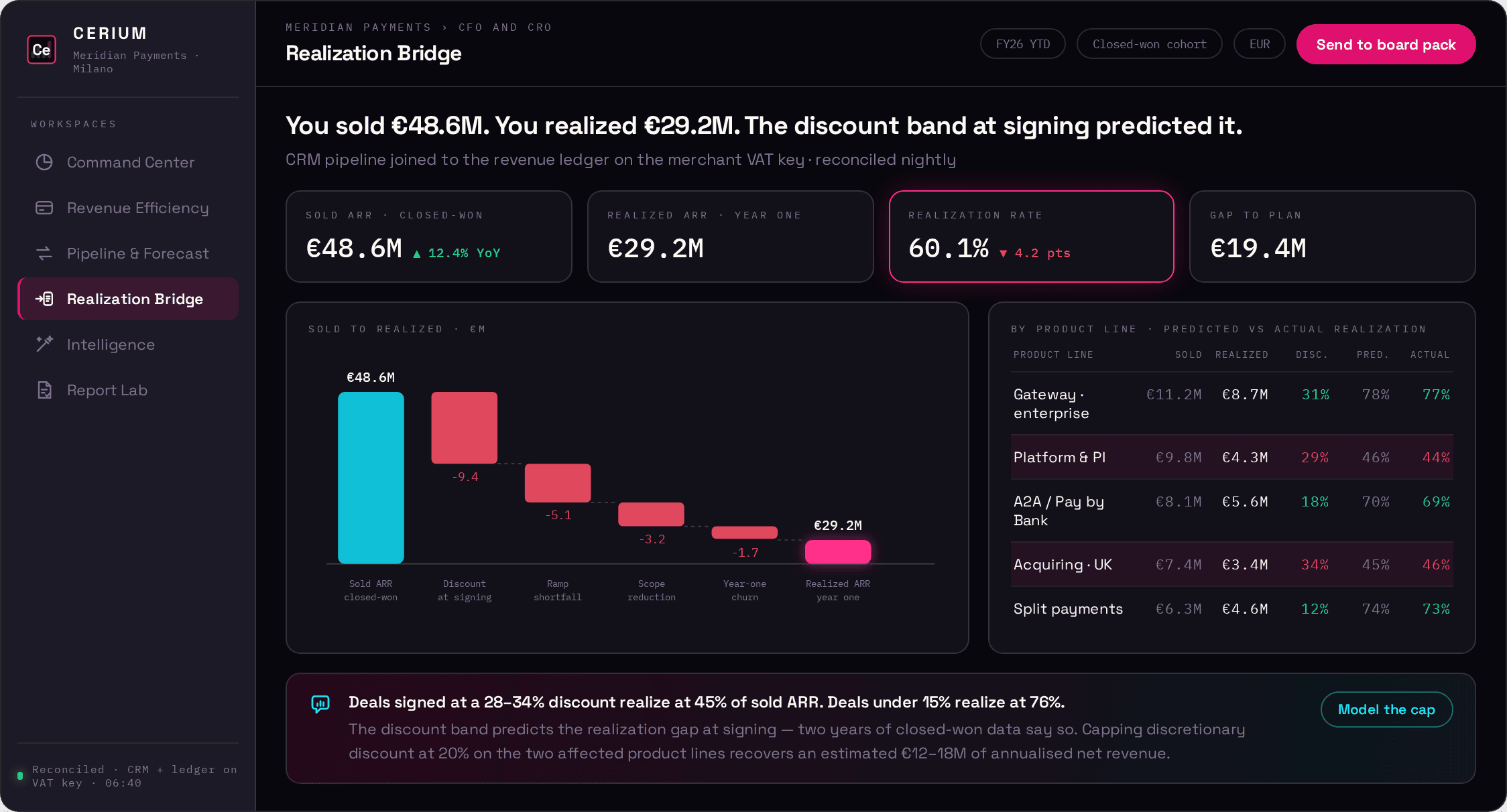
The CRM says one number and the ledger says another. Cerium joins them on the merchant key and decomposes the difference into discount at signing, ramp shortfall, scope reduction and year-one churn.
Yes — at signature. Discount band, product mix and ramp history predict realised revenue before the deal closes, scored against two years of your own closed-won outcomes.
A probabilistic forecast with a P10 to P90 band rather than a single number, plus a scenario simulator that shows what a policy change is worth.
Attrition probability weighted by revenue at risk, so concentration shows up as a named exposure rather than a footnote in a board pack.
A payments platform has an unusually good view of what it sold and an unusually good view of what it earned. What it rarely has is the join between them — and that join is where the money goes.
CRM pipeline and the revenue ledger are owned by different teams, keyed differently, and reconciled by hand at quarter end if at all.
Interchange, scheme fees, split-payment economics and acquirer mix mean gross-to-net is a calculation, not a column.
The discount that creates the gap is granted months before anyone measures it, by someone who will not be in the room when it is discussed.
Two years of CRM and the matching ledger. We will show you your own realisation rate, what predicts it, and what a policy change is worth. You keep the findings either way.